Alfabetul Românieiin 26 (?) issues
0/31read

Documentary series · July 2026 edition

The RomanianAlphabetin 26 issues

A whole country measured letter by letter: from A for Alcohol to Z for Zero new hospitals. Each letter is a series issue with a verified statistic, its explanation and Romania's place in Europe. It reads like an alphabet and ships in instalments.

17.0 litres of pure alcohol per person, per year A · Alcohol
18,300 churches in Romania, against 580 hospitals B · Churches
145,669 children were born in Romania in 2025 N · Births
0 new public hospitals built by the state since the fall of communism Z · Zero

Diacritics included: 31 letters, 31 issues.

The type case

Every issue of the series, in dictionary order. Tap a letter.

Issue 01 / 31

Body & demos

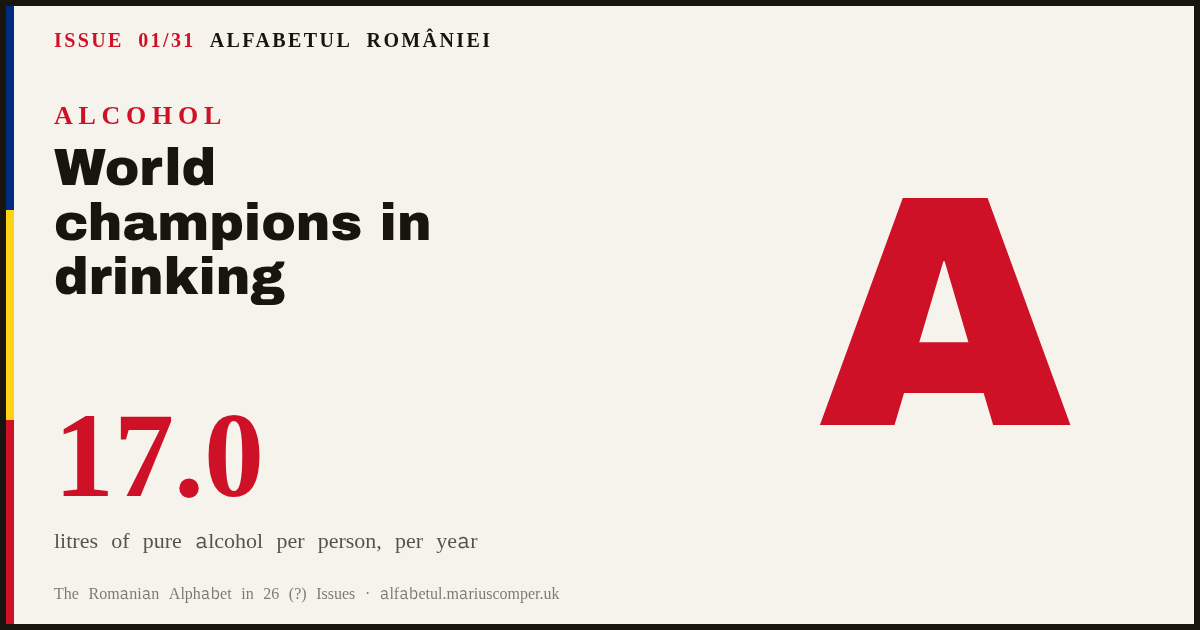
Alcohol

World champions in drinking

17.0litres of pure alcohol per person, per year

In 2019, the average Romanian drank 17 litres of pure alcohol, roughly 18 beers a week, every week of the year. It is the highest per-capita consumption in the world, according to WHO data. And 35% of Romanians report heavy drinking at least once a month, nearly double the European average.

Why it is so

Three things hold each other up: home-made plum brandy, which appears in no sales statistics, low alcohol prices and a huge social tolerance for drinking.

#1 of 190 countries (per-capita consumption)
Sources: [1] [2]

Issue 02 / 31

Everyday lifeRomanian-born letter

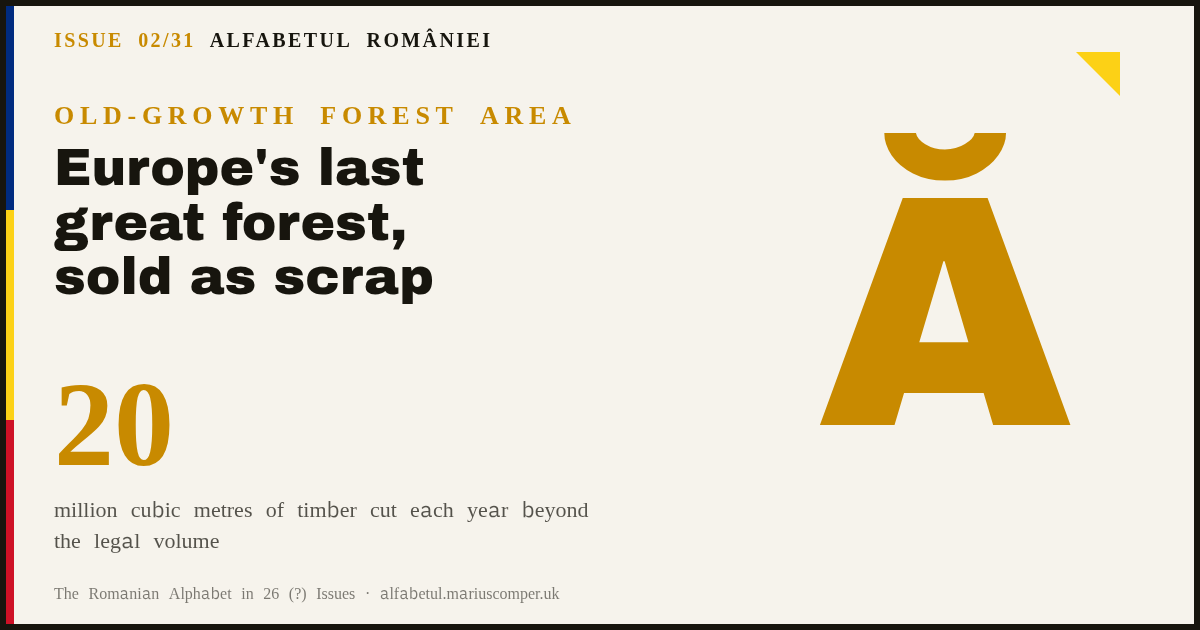
Old-growth forest area

Europe's last great forest, sold as scrap

20million cubic metres of timber cut each year beyond the legal volume

Romania shelters most of the European Union's remaining old-growth forest: 218,500 inventoried hectares. At the same time, the National Forest Inventory estimates that 20 million cubic metres are cut each year beyond the legal volume. That is one truck of timber every 30 seconds, day and night.

Why it is so

European demand for cheap timber, a deliberately weakened chain of controls and a market where legal and stolen wood look identical on paper.

Most old-growth forest in the EU: 218,500 ha

Sources: [3]

Special issue 03 / 31

Language filesRomanian-born letter

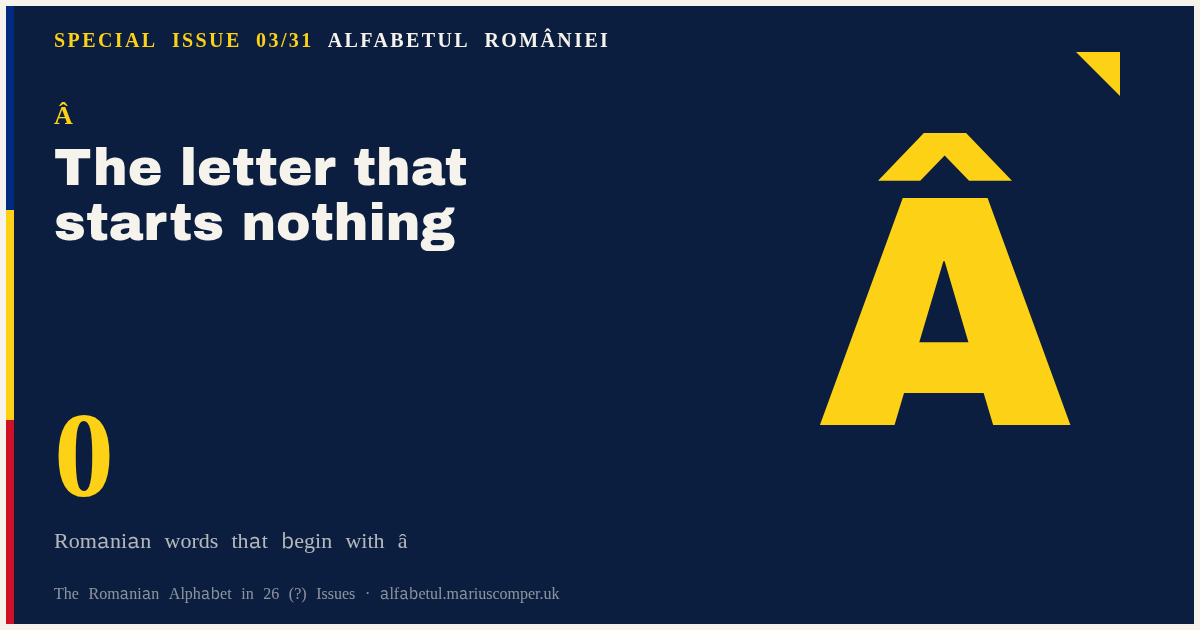
Â

The letter that starts nothing

0Romanian words that begin with â

In standard Romanian, zero words begin with â. The letter lives only inside words: câmp, pâine, mână. Its sound, /ɨ/, opens thousands of words, all of them spelled with î. And without â you cannot even write the country's name: România.

Why it is so

The Academy's 1993 reform drew the line: î at the start and end of words, â inside them. Â remained the alphabet's only strictly interior letter.

Sources: [33]

Issue 04 / 31

Everyday life

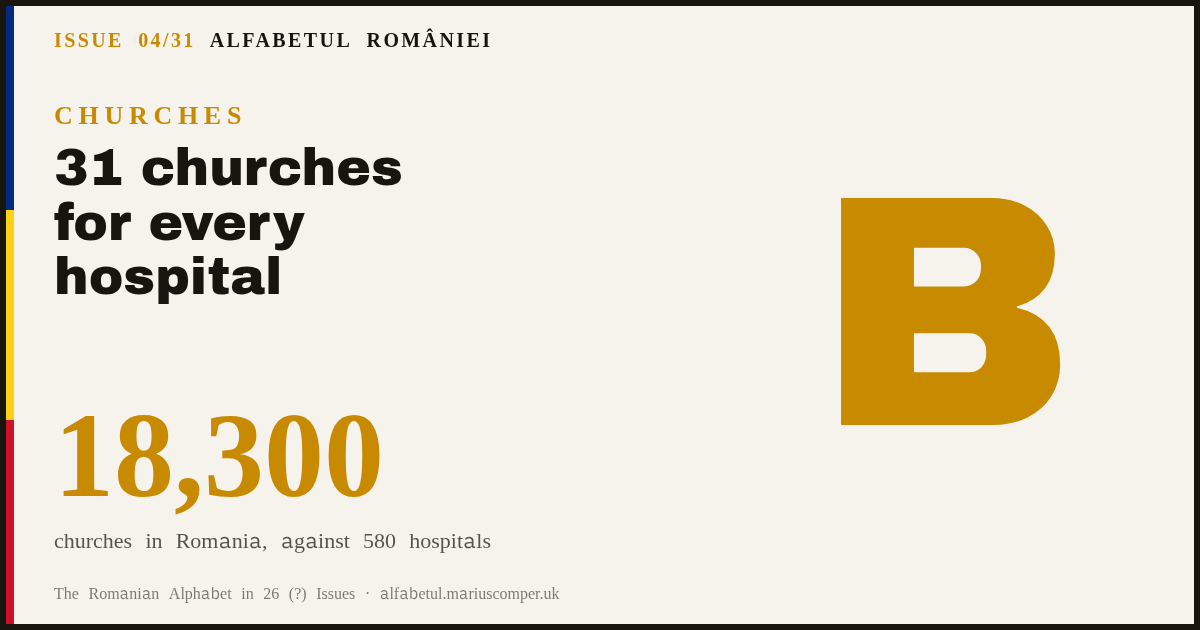
Churches

31 churches for every hospital

18,300churches in Romania, against 580 hospitals

In 2019, Romania counted 18,300 churches and 580 hospitals. For comparison: 4,000 schools, 1,500 high schools, 760 museums and 90 cinemas. Since 1989, thousands of new places of worship have been built, many with public money, while the state has not opened a single new public hospital (see letter Z).

Why it is so

A church is visible, electorally rewarding and easy to consecrate within one term. A hospital takes decades of funding, staffing and accountability, none of which photographs well at a ribbon-cutting.

Sources: [4]

Issue 05 / 31

Body & demos

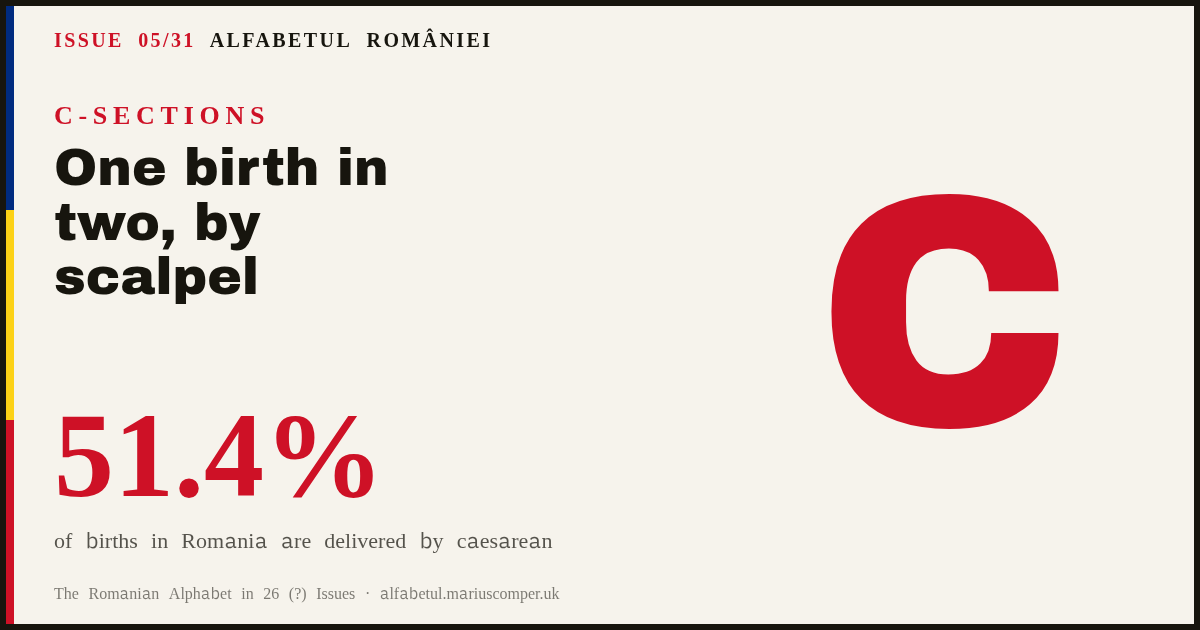
C-sections

One birth in two, by scalpel

51.4%of births in Romania are delivered by caesarean

In 2023, 51.4% of Romanian babies were born by caesarean section, one of the highest rates in Europe. The World Health Organization considers 10-15% the optimal range. Romania crossed that threshold back in 2010 and the curve has climbed ever since.

Why it is so

Doctors shield themselves from malpractice suits, mothers ask for the scheduled date, private hospitals bill it better. An operation designed for emergencies has become a diary appointment.

Sources: [5] [6]

Issue 06 / 31

Body & demos

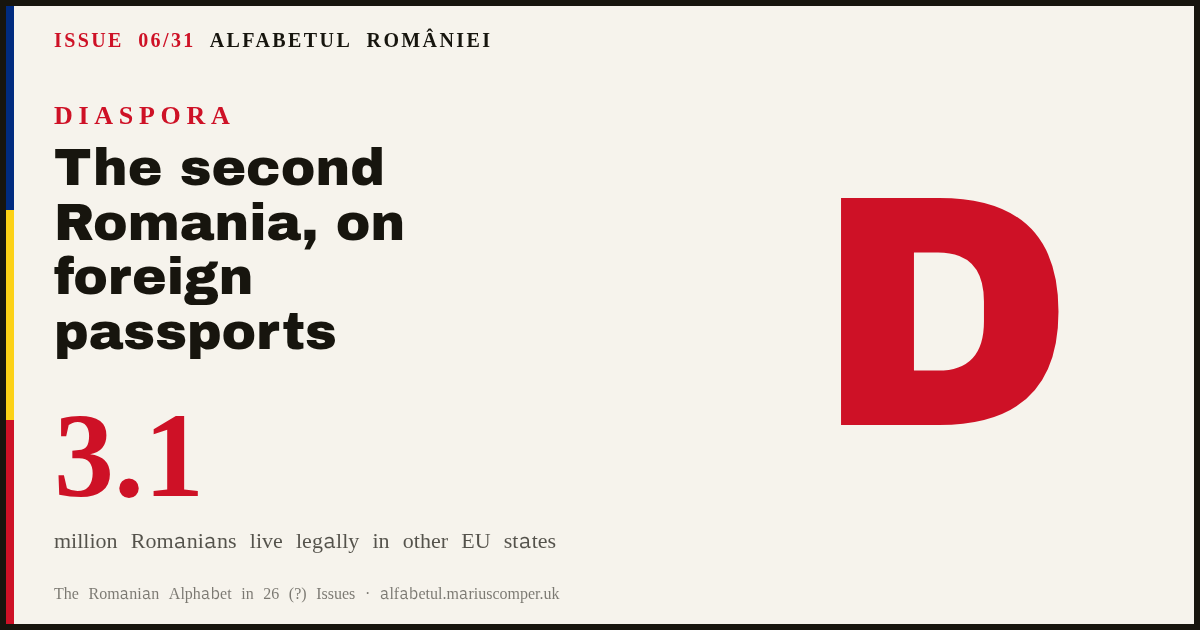
Diaspora

The second Romania, on foreign passports

3.1million Romanians live legally in other EU states

Romanians form the largest group of emigrants in the Union: 3.1 million in other member states, 22% of the total, double the Italian or Polish figures. UN estimates rise to 4.5 million worldwide. Gathered in one place, the diaspora would be Romania's second country, the size of two Bucharests.

Why it is so

They left for salaries three or four times higher and stayed for schools, hospitals and predictability. Around 220,000 have been returning each year recently, yet departures keep the total frozen.

#1 in the EU: 22% of all intra-European emigrants

Sources: [7] [8]

Issue 07 / 31

Money & institutions

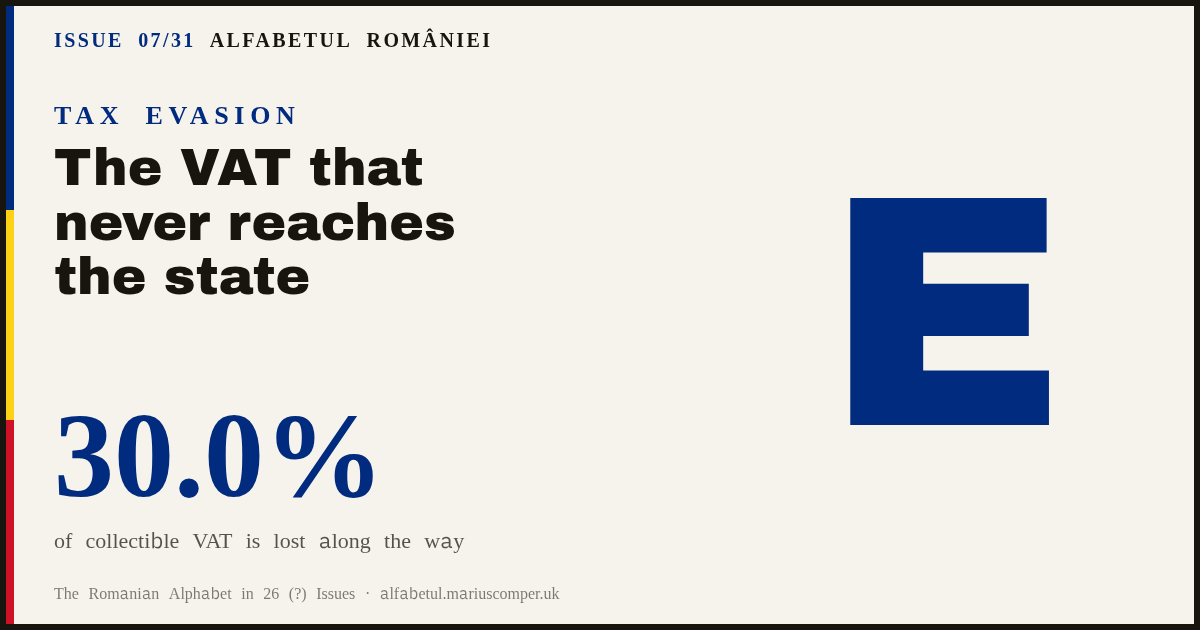
Tax evasion

The VAT that never reaches the state

30.0%of collectible VAT is lost along the way

Romania has the largest VAT gap in the European Union: 30% of what the state should collect evaporates between the receipt and the budget, the European Commission's report for 2023 shows. In money, that means billions of euros a year, enough to cover a major ministry's deficit several times over.

Why it is so

The shadow economy (see letter U), an underpowered tax authority digitalised on paper and decades of amnesties that taught companies that waiting is the best fiscal strategy.

#1 in the EU for the VAT gap (2023)

Sources: [9]

Issue 08 / 31

Money & institutions

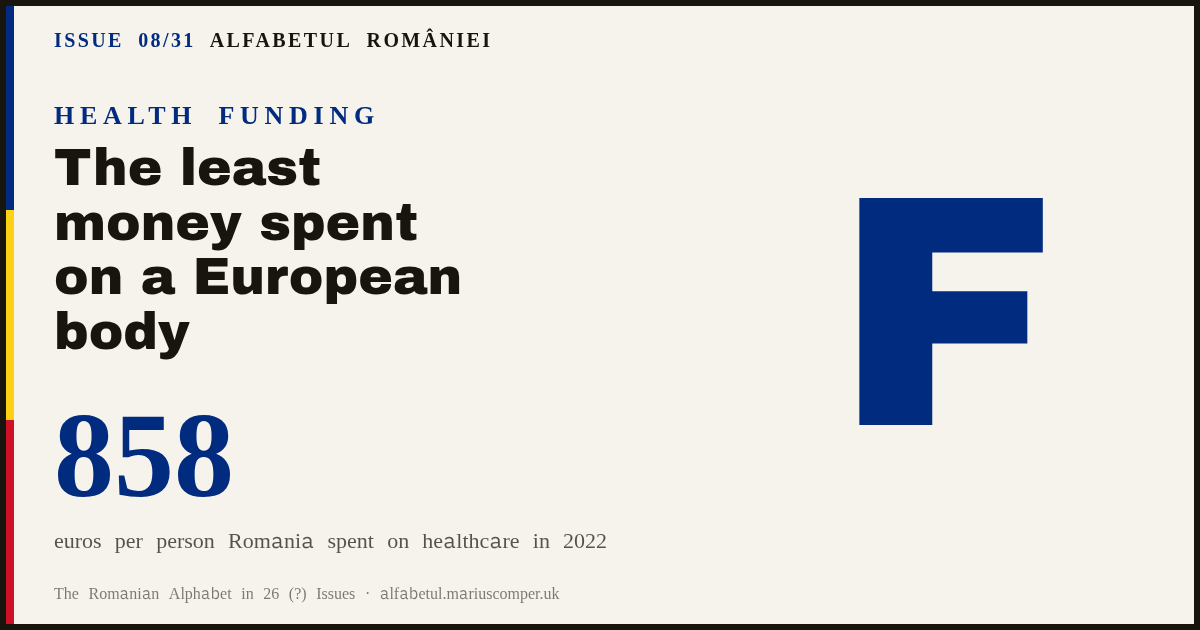
Health funding

The least money spent on a European body

858euros per person Romania spent on healthcare in 2022

Last place in the EU for healthcare spending per person: 858 euros, against a European average of 3,685 and Luxembourg's 6,590, which is 7.7 times more. The paradox: Romania has some of the most hospital beds in the EU, 731 per 100,000 people.

Why it is so

Beds we have, a system we do not: money flows to inpatient care, primary medicine is bypassed and 12% of the population is not even insured.

#27 of 27 for per-person health spending

Sources: [10] [2]

Issue 09 / 31

Everyday life

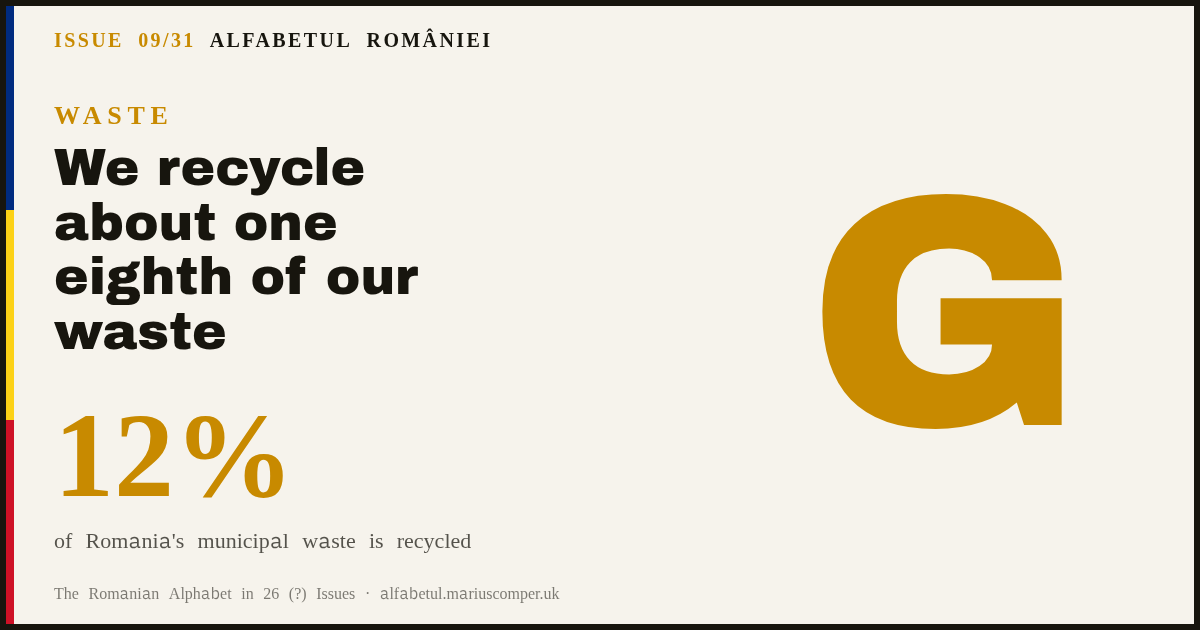
Waste

We recycle about one eighth of our waste

12%of Romania's municipal waste is recycled

Only 12% of municipal waste was recycled in 2022, last place in the EU and far from the 49% average. The rest goes almost entirely to landfill: 74% dumped directly. The European target for 2025 is 55%, and Romania is a third of the way there.

Why it is so

Optional separate collection, almost no composting and landfill taxes so low that the dump remains the cheapest recycling technology in the country.

#27 of 27 in recycling

Sources: [11]

Issue 10 / 31

Everyday life

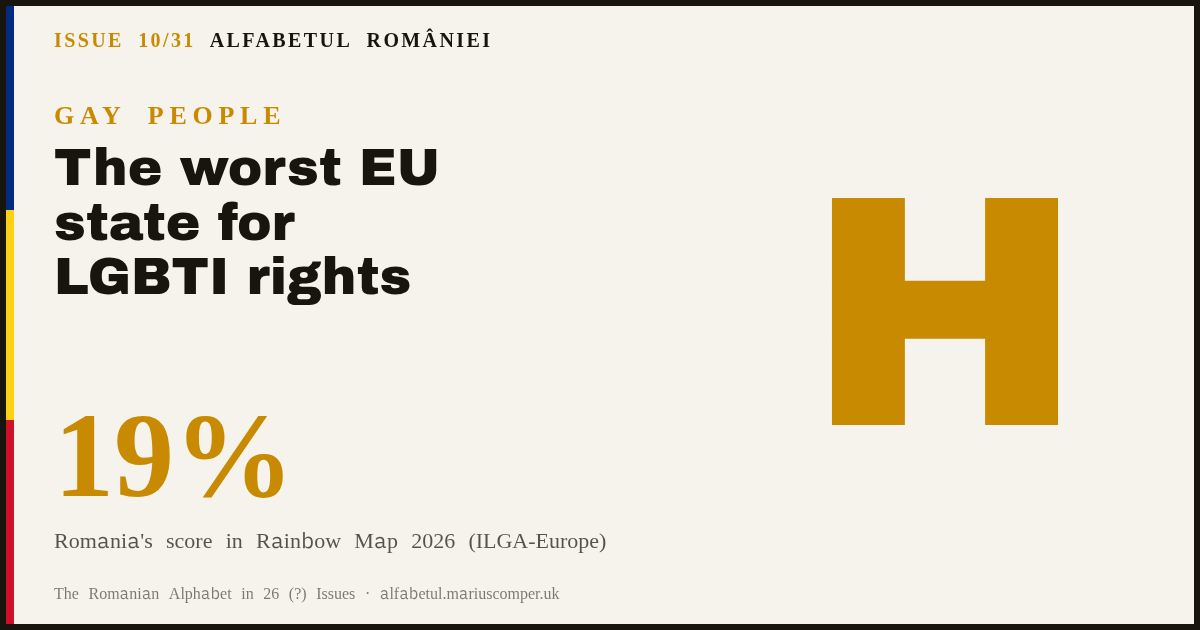
Gay people

The worst EU state for LGBTI rights

19%Romania's score in Rainbow Map 2026 (ILGA-Europe)

With 19 points out of 100, Romania is the lowest-ranked EU member state on the map of LGBTI rights: 42nd of 49 European countries. No civil partnership, no full protection against hate speech, no legal gender recognition.

Why it is so

Legislation froze in the 2000s, the 2018 referendum consumed both camps' energy and no majority since has taken ownership of the subject.

42nd of 49 in Europe; last among EU member states

Sources: [12]

Issue 11 / 31

Everyday life

Internet

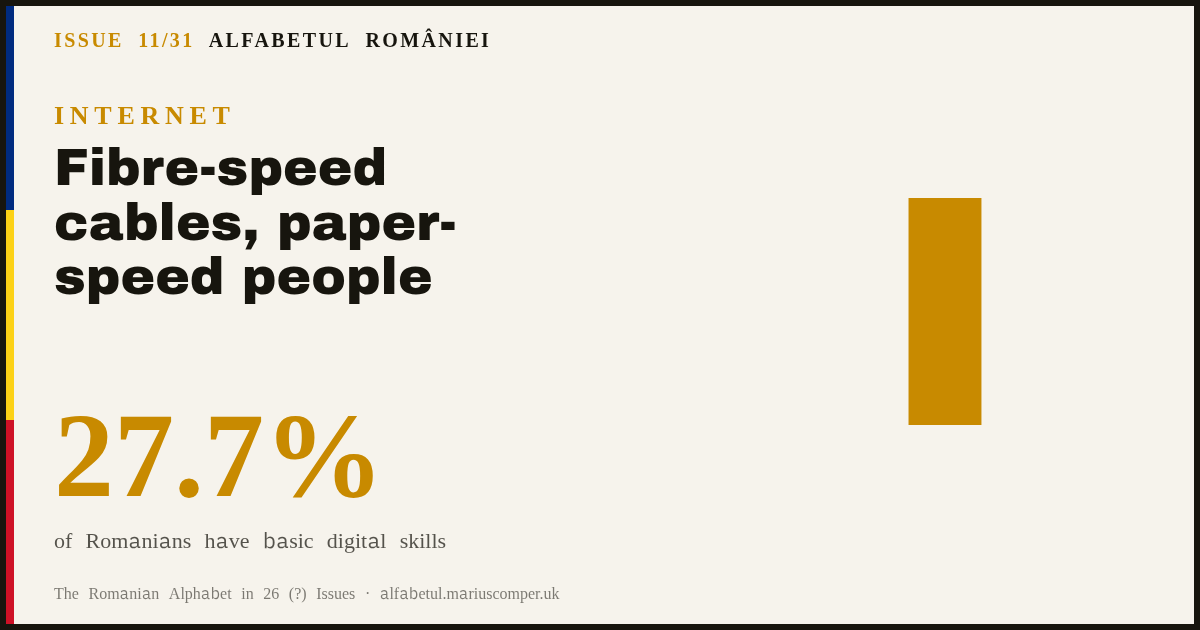
Fibre-speed cables, paper-speed people

27.7%of Romanians have basic digital skills

Romania has one of the best fibre infrastructures in the EU, with very-high-capacity network coverage above the European average. And yet only 27.7% of Romanians have basic digital skills: last place in the Union, at half the 55.6% average.

Why it is so

The internet arrived fast and cheap, digital literacy slow and barely at all (see letter Î). The network belongs to the 21st century, the curriculum stayed two centuries behind.

#27 of 27 in digital skills

Sources: [13]

Issue 12 / 31

Everyday lifeRomanian-born letter

Education

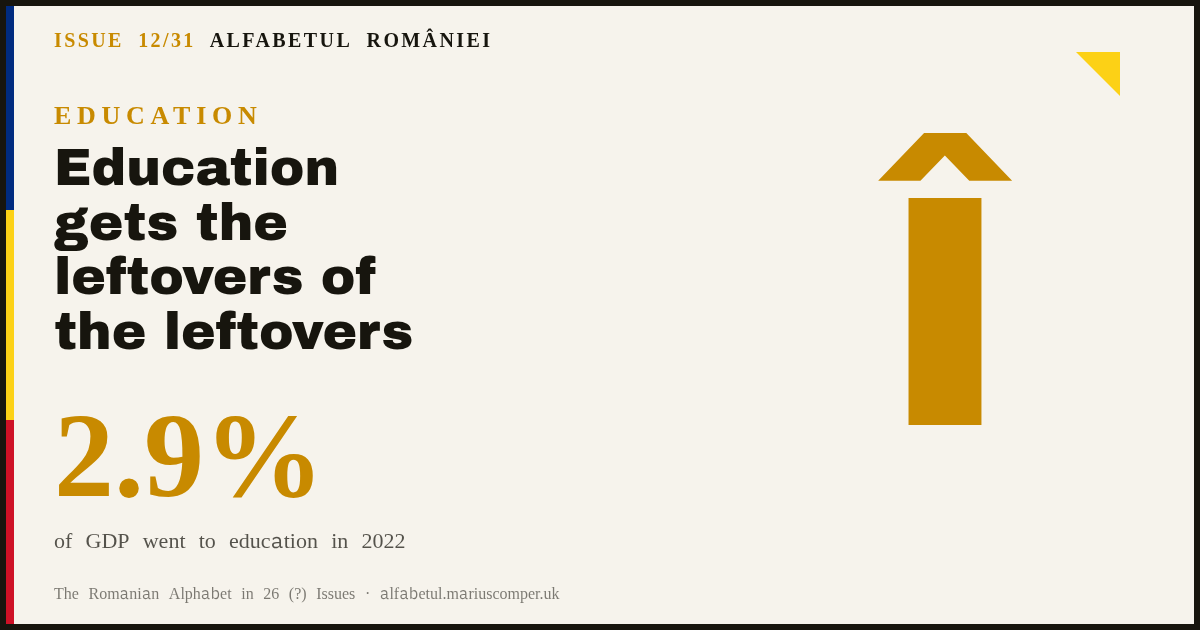
Education gets the leftovers of the leftovers

2.9%of GDP went to education in 2022

2.9% of GDP for education: the smallest share in the EU, against a European average of 4.6%. The law demands 6%. The yearly difference is roughly the budget of a whole ministry that is not called Education.

Why it is so

Spending on schools brings no votes in four years, it brings results in twenty. The electoral cycle and the educational one have never met.

#27 of 27 in education funding

Sources: [14]

Issue 13 / 31

Money & institutions

Gambling

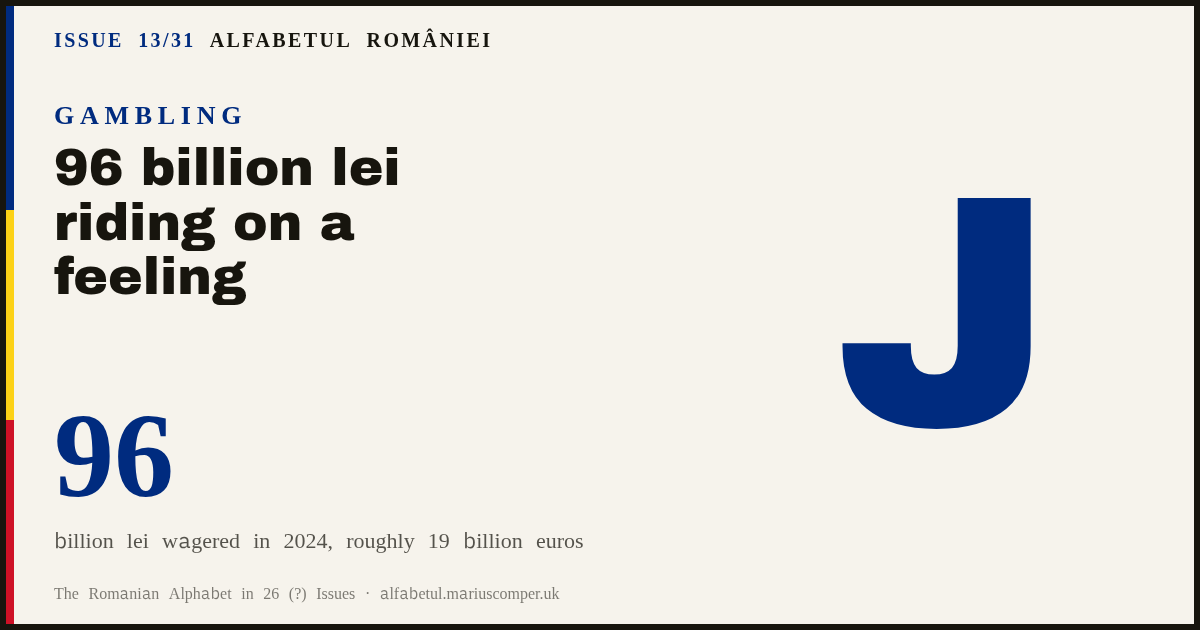
96 billion lei riding on a feeling

96billion lei wagered in 2024, roughly 19 billion euros

Romanians wagered more than 96 billion lei on gambling in 2024, the Court of Accounts audit shows. Around 1.1 million active players and 464 licensed companies. The same Court found a fiscal risk of 3.1-3.6 billion lei, because the watchdog simply never audited the online operators.

Why it is so

Aggressive advertising on every screen, slot halls on every street corner and a regulator that for years had not even a terminal to access the data of the companies it licensed.

1.1 million active players, 464 licensed companies

Sources: [15] [16]

Issue 14 / 31

Money & institutions

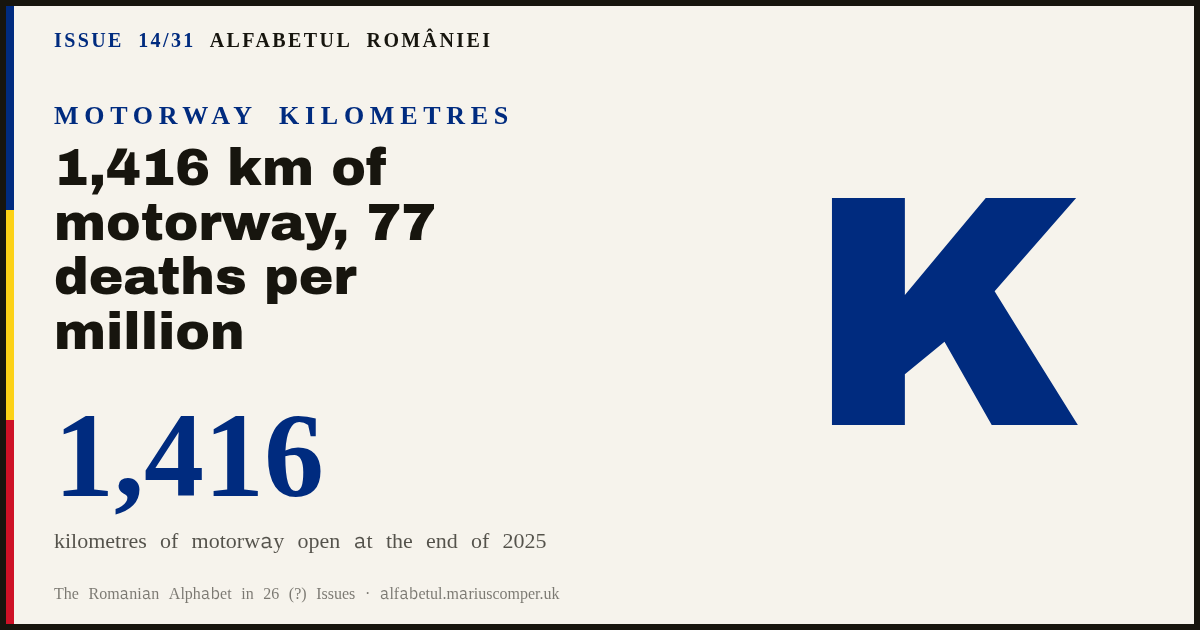
Motorway kilometres

1,416 km of motorway, 77 deaths per million

1,416kilometres of motorway open at the end of 2025

Romania's entire motorway network equals the distance from Bucharest to Vienna. And because the remaining roads are crowded and dangerous: 77 deaths per million people in 2024, the highest rate in the EU, against a European average of 45.

Why it is so

Thirty years of cancelled tenders, routes redrawn on paper and contractors paid to wait. The motorway is the national objective postponed from one term to the next.

#1 in the EU for road mortality

Sources: [17] [18]

Issue 15 / 31

Everyday life

Housing

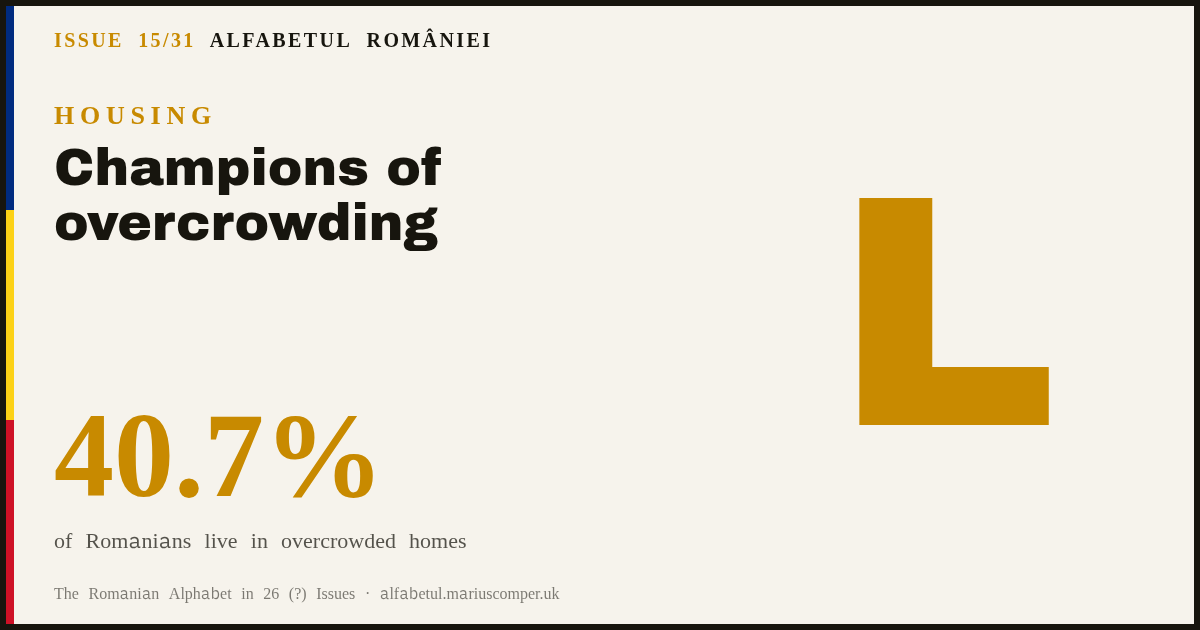
Champions of overcrowding

40.7%of Romanians live in overcrowded homes

The highest housing overcrowding rate in the EU: 40.7% in 2024, against a European average of 16.9%. Romania is also the champion of private ownership: over 95% of residents own the home they live in. We have houses, we do not have space.

Why it is so

Big-city prices have outrun wages, the old housing stock is split between generations and the rental market is grey, expensive and insecure.

#1 in the EU for overcrowded housing

Sources: [19]

Issue 16 / 31

Body & demos

Infant mortality

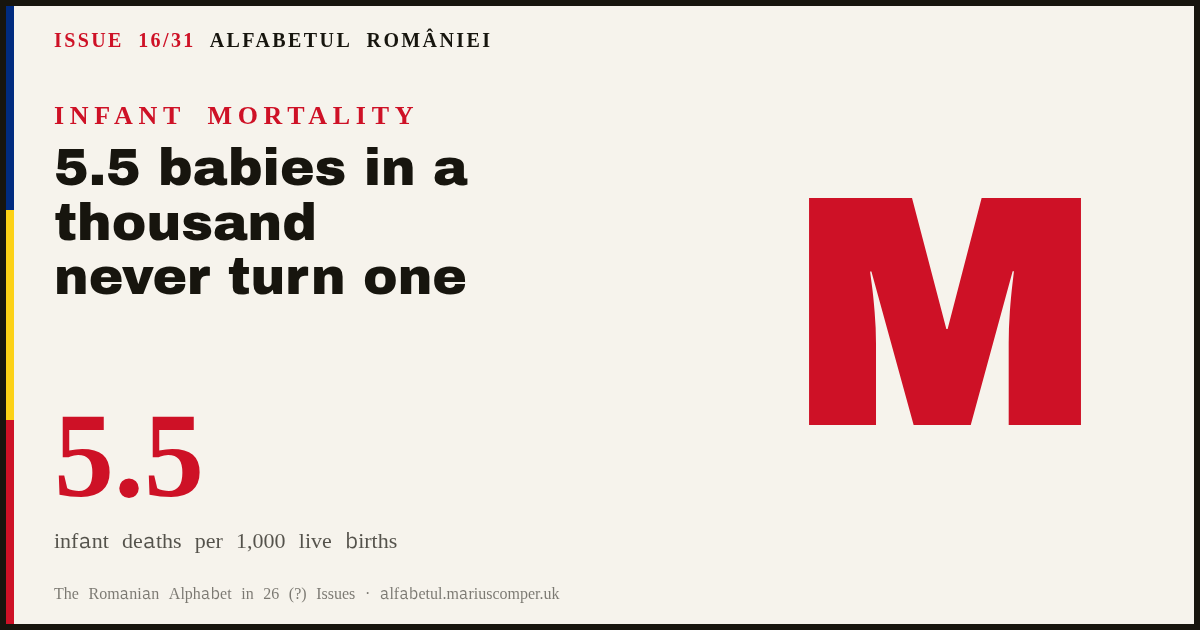
5.5 babies in a thousand never turn one

5.5infant deaths per 1,000 live births

The highest infant mortality rate in the EU: 5.5 deaths per 1,000 live births in 2022, nearly double the 3.3 average. In Estonia the rate is below 2. There is progress, but the gap with the rest of Europe is as wide as it was two decades ago.

Why it is so

Premature births not treated in time, mothers who never reach check-ups, rural areas hours away from a neonatal ward. The infant mortality map is, millimetre for millimetre, the map of access to medicine.

#1 in the EU for infant mortality

Sources: [20]

Issue 17 / 31

Body & demos

Births

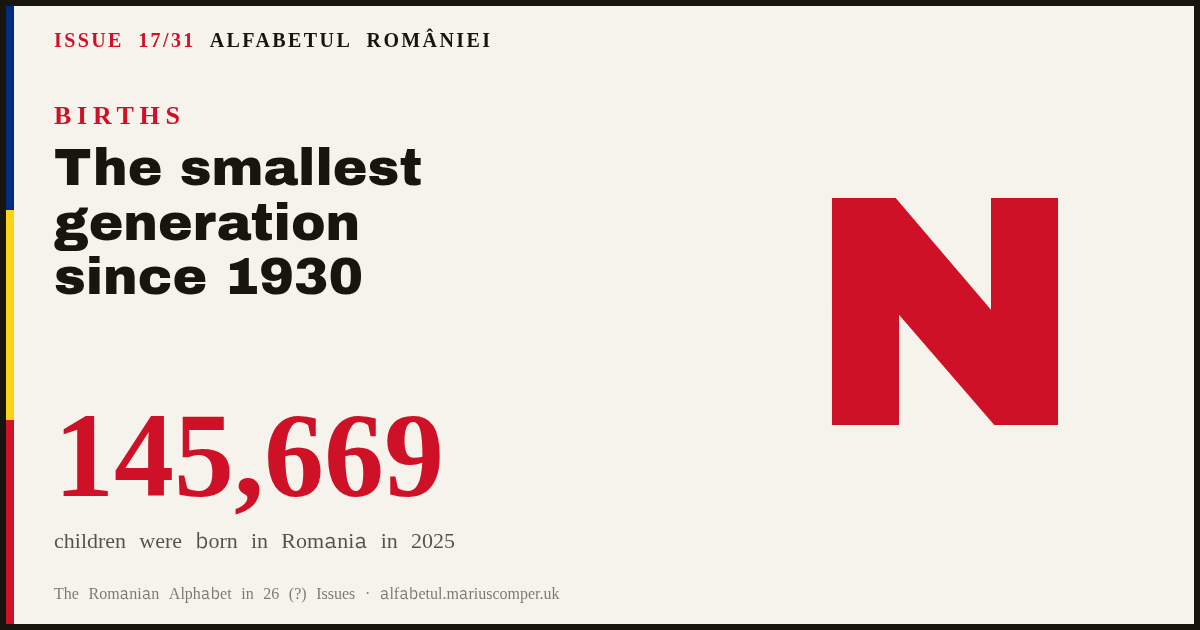
The smallest generation since 1930

145,669children were born in Romania in 2025

The smallest number of births in nearly a century: 145,669 in 2025, according to the National Institute of Statistics. In 1990 there were 314,746 births, at the 1967 peak there were 527,764. The decline from the peak exceeds 70%.

Why it is so

Today's mothers are the small generation born after 1990, many people of fertile age live in the diaspora, and nurseries, housing prices and economic safety weigh as much as biology.

Sources: [21]

Issue 18 / 31

Body & demos

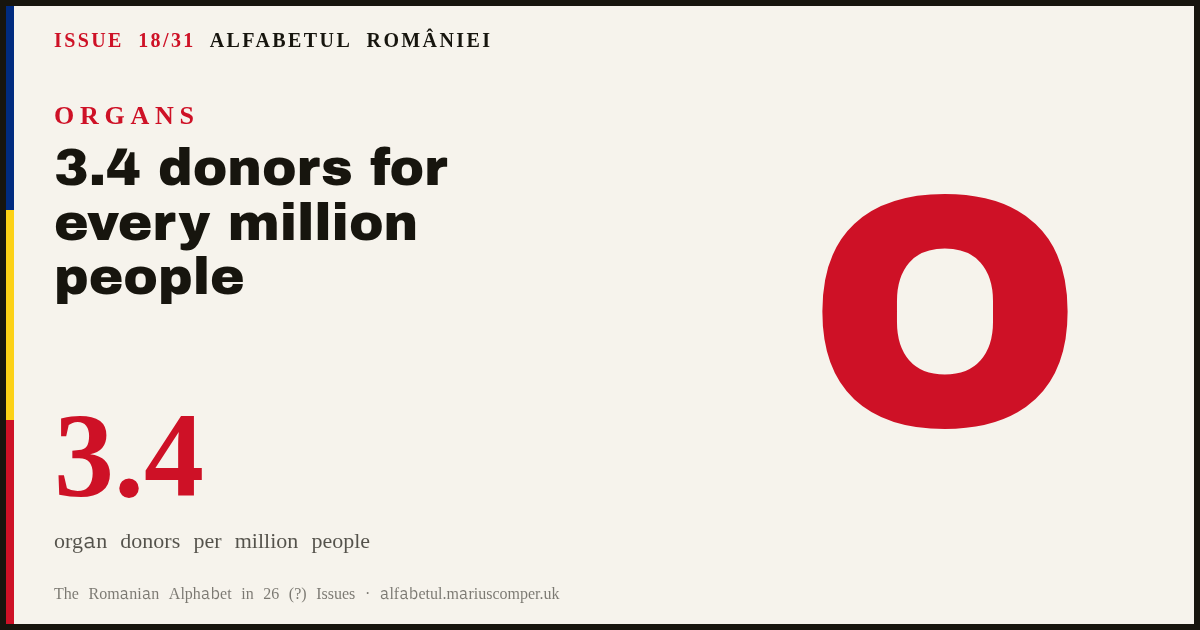
Organs

3.4 donors for every million people

3.4organ donors per million people

Second-to-last in the EU for organ donation: 3.4 donors per million people in 2020. Spain, the world leader, has 47. Every point of difference means lives lost on waiting lists that here end too early far too often.

Why it is so

It is not Romanians refusing, it is the system: few hospitals equipped for retrieval, rare transplant coordinators and a procedure that leaves the decision on the family's shoulders exactly when no one can decide.

#26 of 27 in organ donation

Sources: [22]

Issue 19 / 31

Body & demos

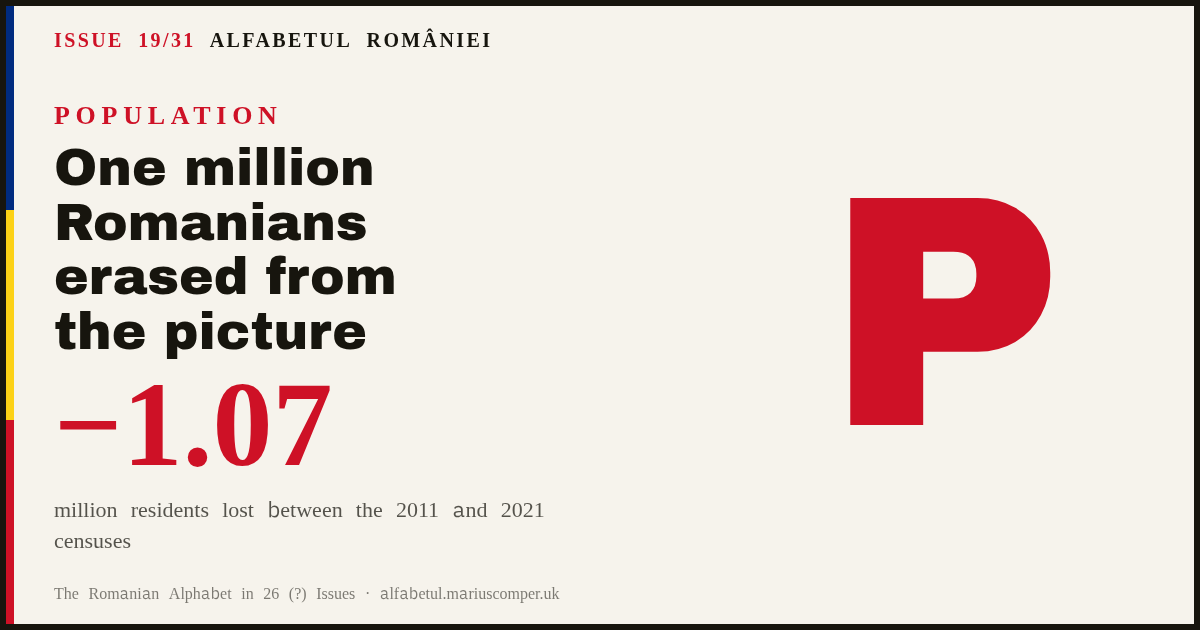
Population

One million Romanians erased from the picture

−1.07million residents lost between the 2011 and 2021 censuses

From 20.12 million in 2011 to 19.05 million in 2021: Romania lost, in one decade, the equivalent of its second-largest city. And the decline is accelerating, from two directions that add up: fewer births (letter N) and more departures (letter D).

Why it is so

A natural decrease going back decades plus net emigration. We did not lose a war, we only lost the present.

Sources: [23]

Special issue 20 / 31

Language filesborrowed letter

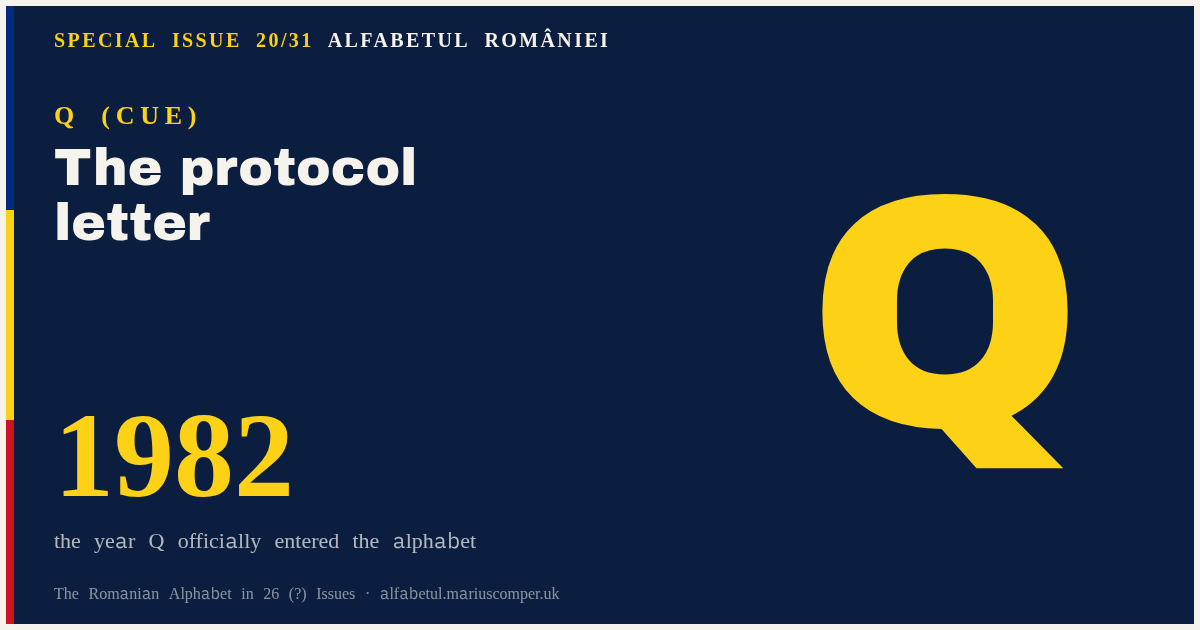
Q (cue)

The protocol letter

1982the year Q officially entered the alphabet

Q was only recognised in 1982 and begins no native Romanian word. It lives in loanwords and foreign names alone: quasar, Qatar, QWERTY. A letter we own, yet almost never use to say anything of our own.

Why it is so

The Romanian Latin alphabet, adopted in the 19th century, was built around the sounds of the language; it had nothing to hang on q, so it left it waiting for a century.

Sources: [33]

Issue 21 / 31

Everyday life

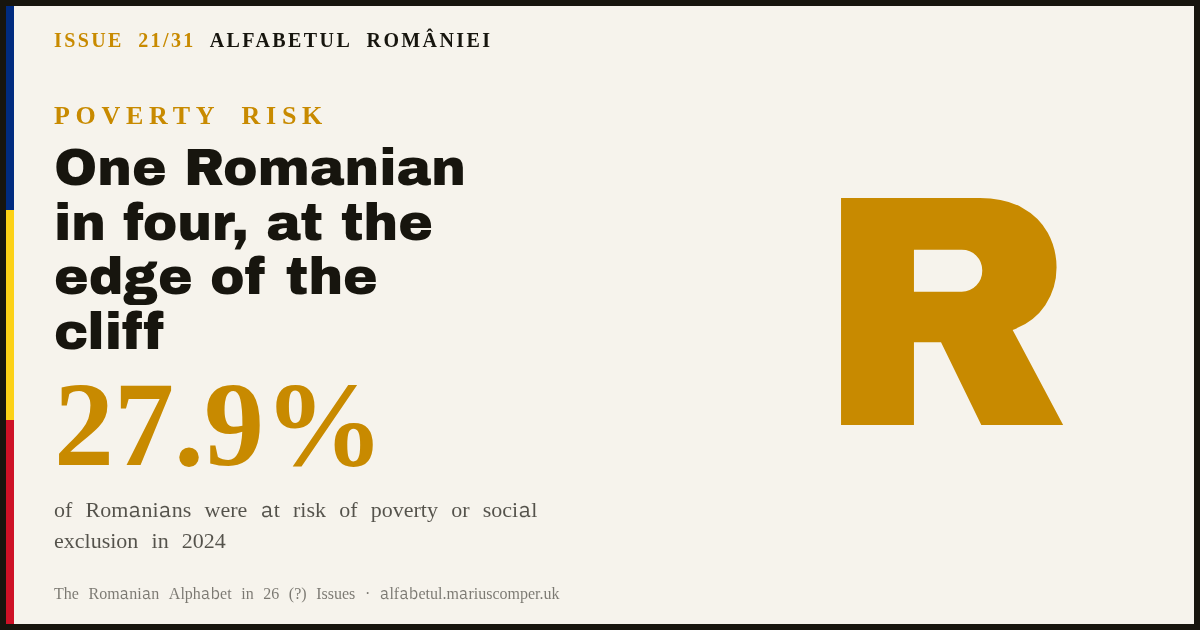
Poverty risk

One Romanian in four, at the edge of the cliff

27.9%of Romanians were at risk of poverty or social exclusion in 2024

The second-highest rate in the EU after Bulgaria, far from the 21% average. In 2023 Romania was actually first, at 32%. Poverty here is also concentrated: in the Bucharest-Ilfov region the risk was 12.3%, while half the country exceeds a third.

Why it is so

Low wages gathered in a handful of cities, meagre pensions for the majority, benefits that offset little and prices that long ago became European prices.

#2 in the EU, after Bulgaria (30.3%)

Sources: [24]

Issue 22 / 31

Body & demos

Life expectancy

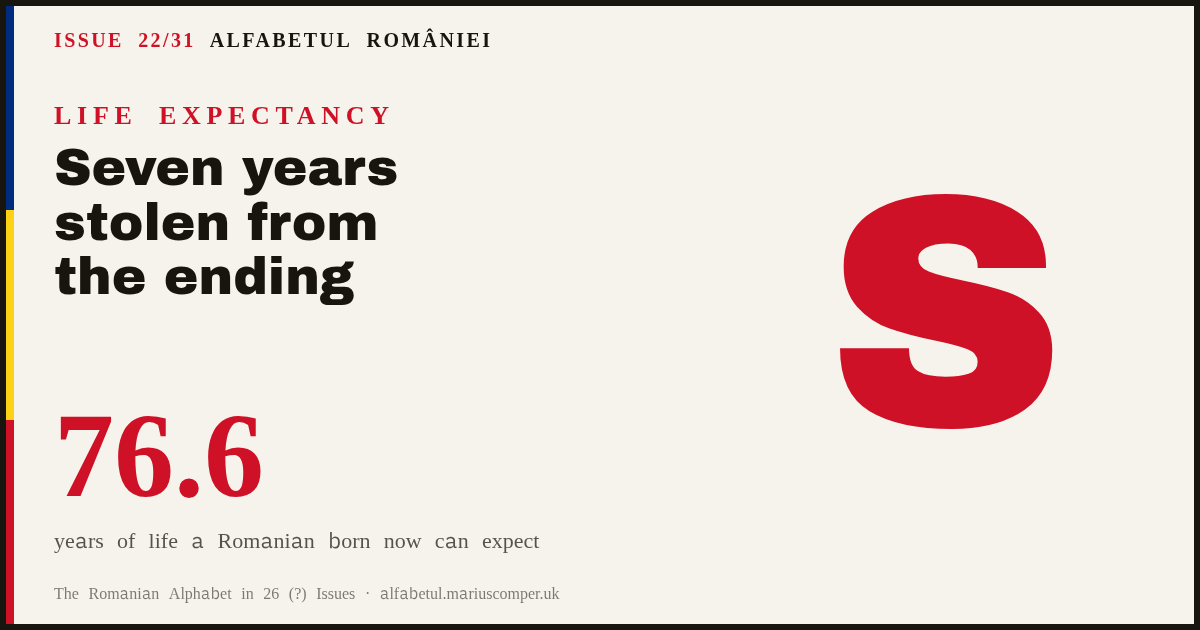
Seven years stolen from the ending

76.6years of life a Romanian born now can expect

Among the lowest life expectancies in the EU: 76.6 years in 2024, against a European average of 81.7. A Spaniard lives 84. The gap to Europe's leaders is more than seven years, roughly a quarter of a generation.

Why it is so

The EU's highest treatable mortality and its highest preventable mortality, the funding from letter F and the lifestyle from letter A. Life expectancy is the sum of all the other letters.

Sources: [25] [2]

Issue 23 / 31

Money & institutionsRomanian-born letter

Bribes

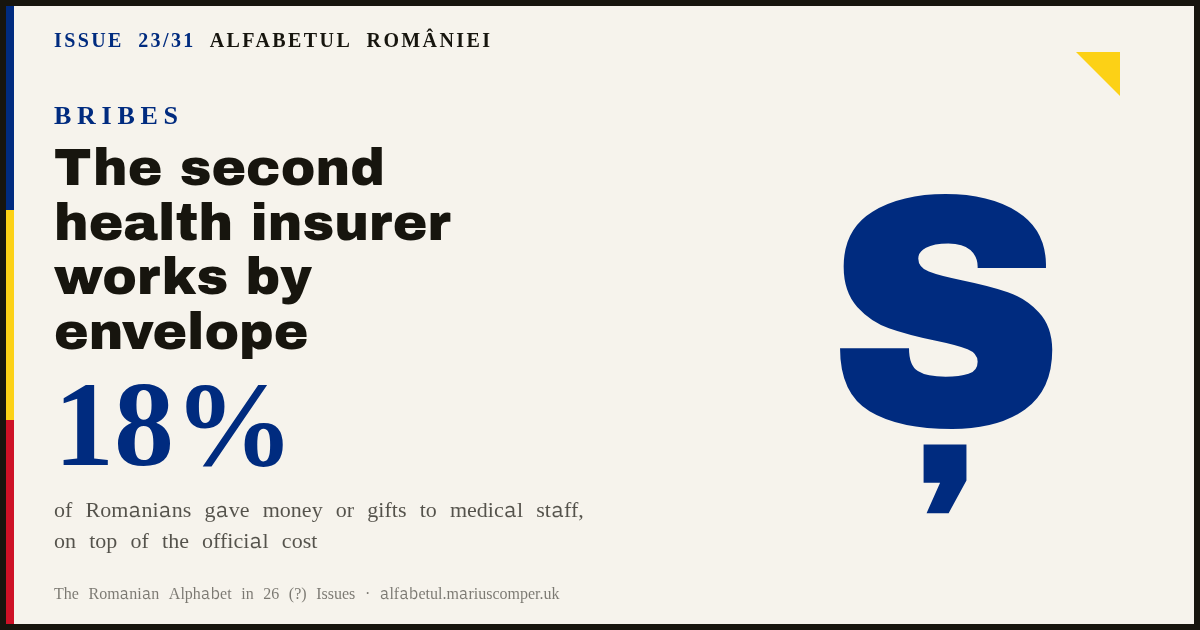
The second health insurer works by envelope

18%of Romanians gave money or gifts to medical staff, on top of the official cost

In 2022, 18% of Romanians admitted to an informal payment to doctors or nurses: the highest share in the EU, against a 4% average. In the country with the least public money per patient, the envelope works as a second health insurer.

Why it is so

Chronically low wages in the system, inherited habit and patients paying out of fear. Informal medicine covers the holes of the formal one and keeps widening them.

#1 in the EU for informal health payments

Sources: [2]

Issue 24 / 31

Everyday life

NEET youth

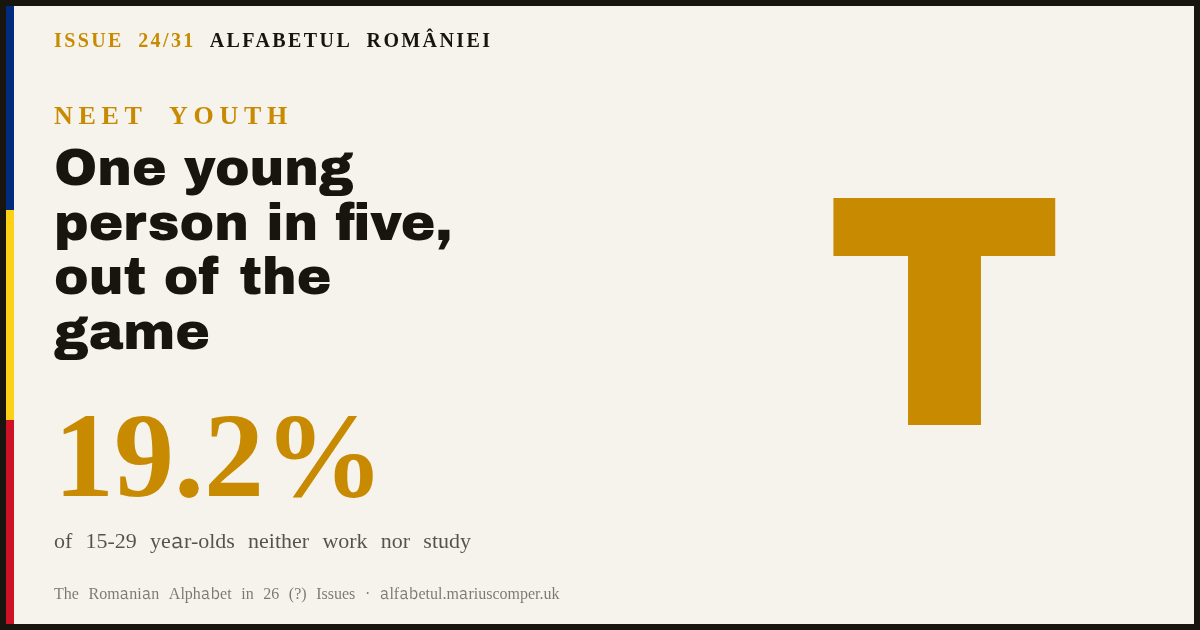
One young person in five, out of the game

19.2%of 15-29 year-olds neither work nor study

The highest NEET rate in the EU in 2025: 19.2%, against a European average of 11% and a low of 5.3% in the Netherlands. Nearly a million young Romanians sit outside both work and school, precisely in the years that should be their most productive.

Why it is so

High dropout rates, vocational schools decoupled from the market, regions with no employers at all and a generation for which emigration remains plan A.

#1 in the EU for NEET youth

Sources: [26]

Issue 25 / 31

Everyday lifeRomanian-born letter

Peasants

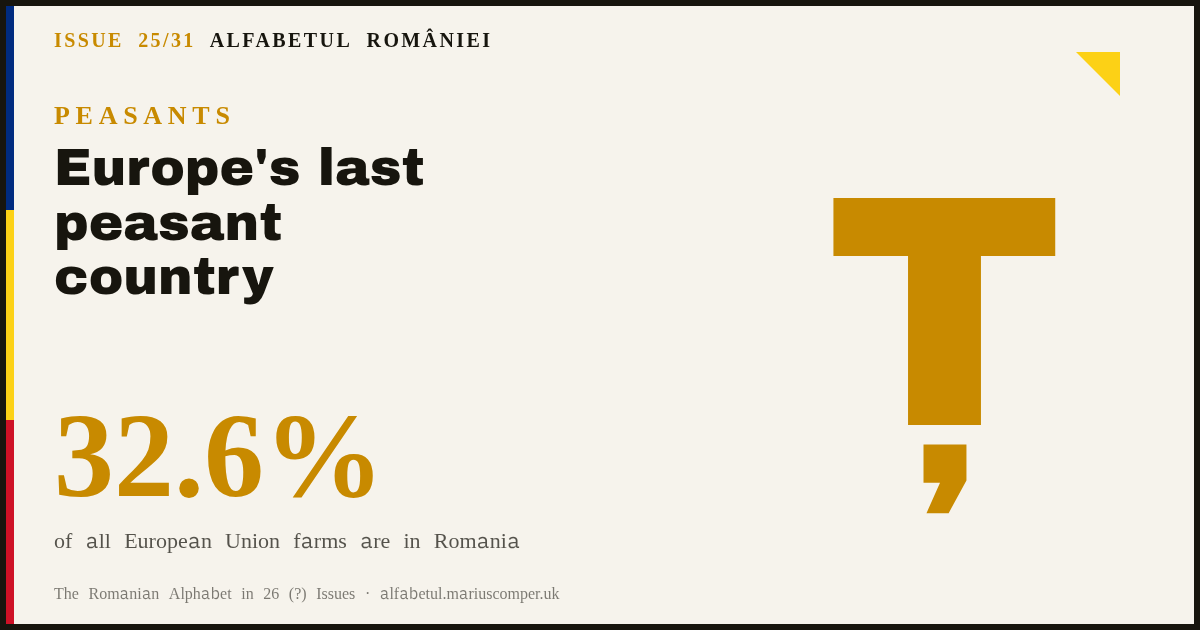
Europe's last peasant country

32.6%of all European Union farms are in Romania

2.9 million farms, twice as many as any other European country. Together they produce just 3.7% of the EU's agricultural output. The average Romanian farm spans some 4.4 hectares, against a European average of 17.8.

Why it is so

Land fragmented by inheritance for thirty years, a museum-grade machinery fleet and an agricultural policy that subsidised survival, not the move to scale.

#1 in the EU for number of farms

Sources: [27]

Issue 26 / 31

Money & institutions

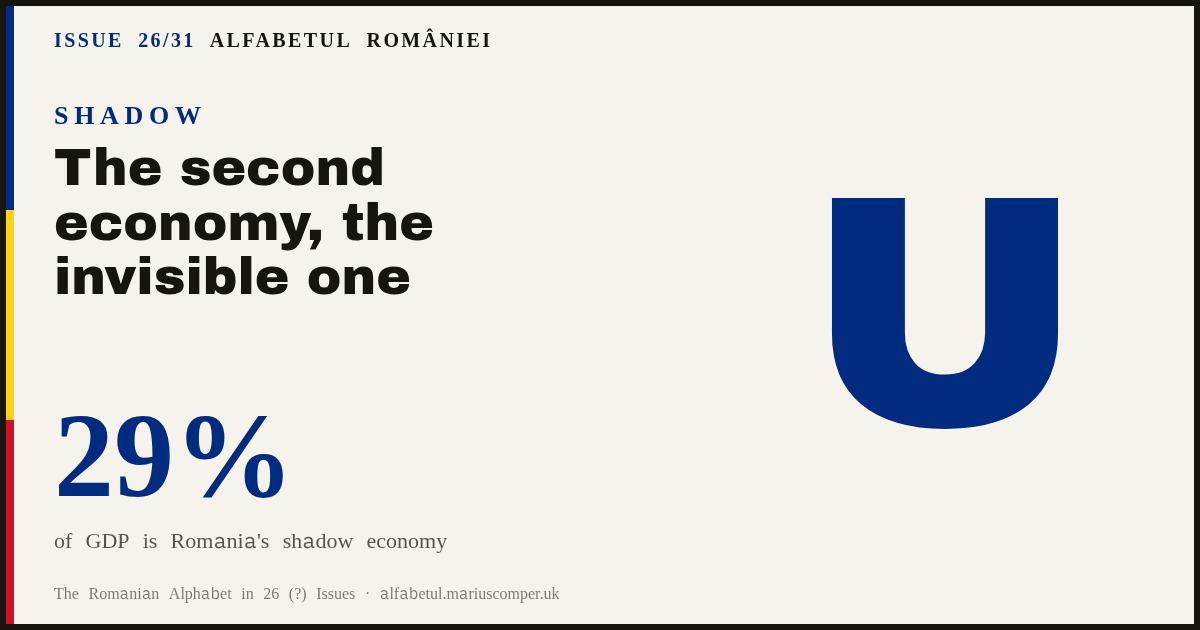
Shadow

The second economy, the invisible one

29%of GDP is Romania's shadow economy

One leu in three moves without a receipt and without a contract: the shadow economy is estimated at 29% of GDP in 2022, among the largest in the EU, against an average of about 17%. This is where the VAT gap from letter E begins.

Why it is so

Undeclared work in agriculture and construction, low fiscal trust in both directions and a cost of compliance felt as heavier than the risk of punishment.

Sources: [28]

Issue 27 / 31

Everyday life

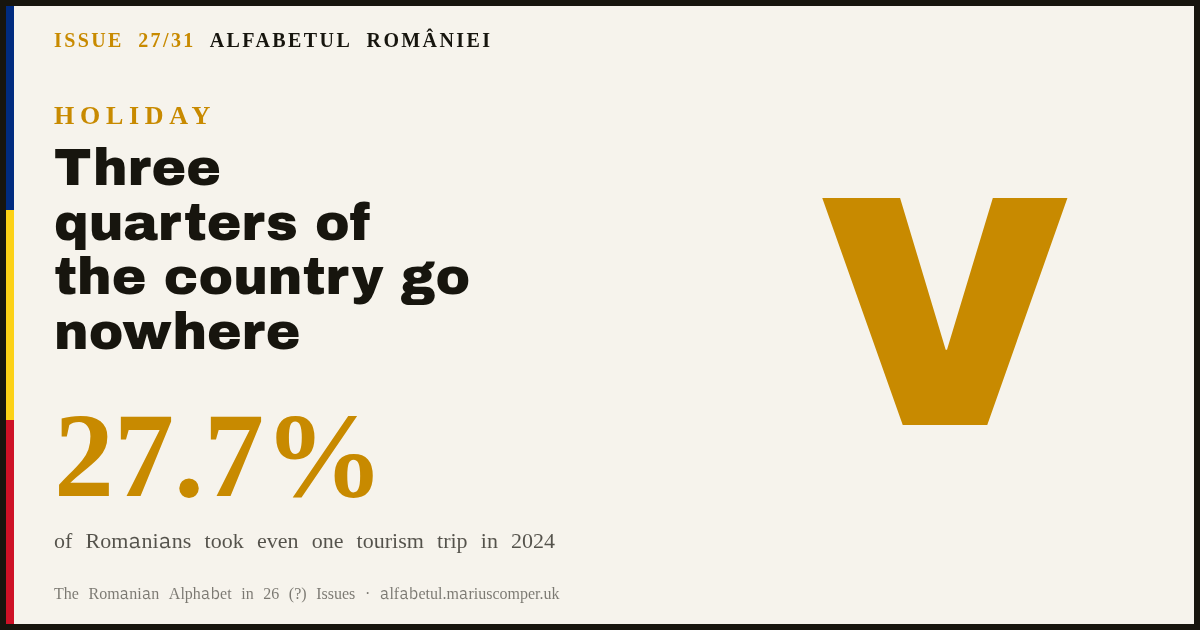
Holiday

Three quarters of the country go nowhere

27.7%of Romanians took even one tourism trip in 2024

Last place in the EU for tourism participation: 27.7%, against an average of 65.4% and a high of 83.6% in the Netherlands. For most Romanians, time off goes to errands, and a real holiday remains a project to be planned for years.

Why it is so

Little money left after bills (letters F and R), days off spent on errands and a geography where the sea and the mountains are close but the budget is far.

#27 of 27 in holidays

Sources: [29]

Special issue 28 / 31

Language filesborrowed letter

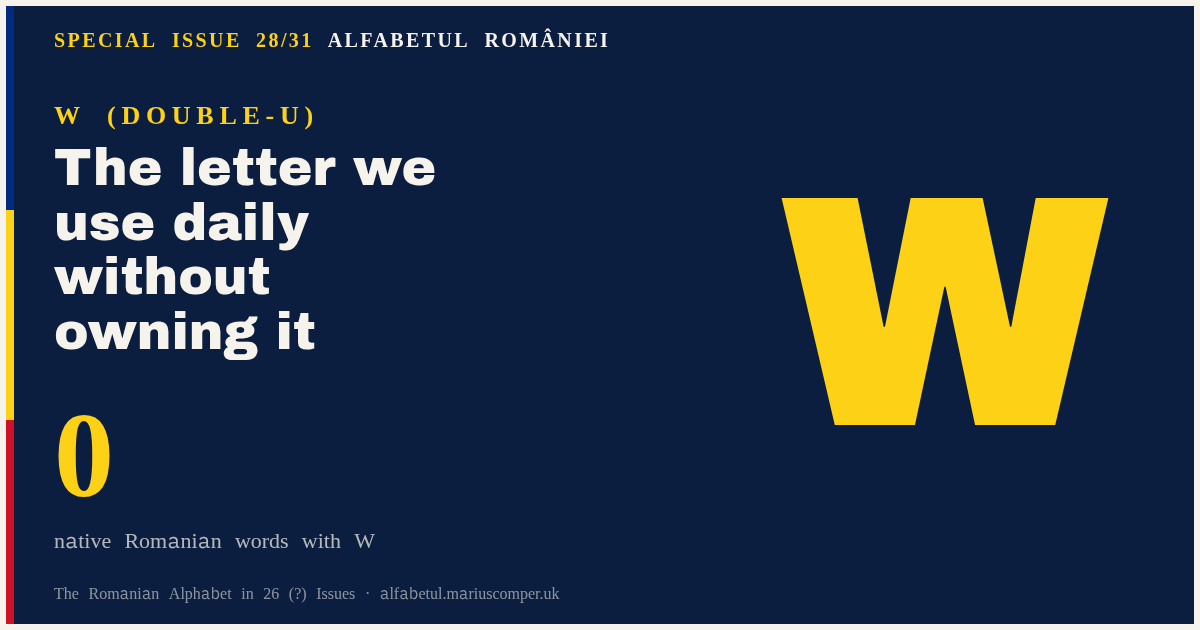
W (double-u)

The letter we use daily without owning it

0native Romanian words with W

W neither begins nor belongs to any native Romanian word. And yet it may be the foreign letter with the biggest daily presence: weekend, web, watt, wifi, sandwich. Official since 1982, it lives exclusively in loanwords.

Why it is so

The /w/ sound does not exist in Romanian, so we pronounce it /v/. The letter stayed on, like a passport stamp, on things that came from abroad.

Sources: [33]

Issue 29 / 31

Everyday life

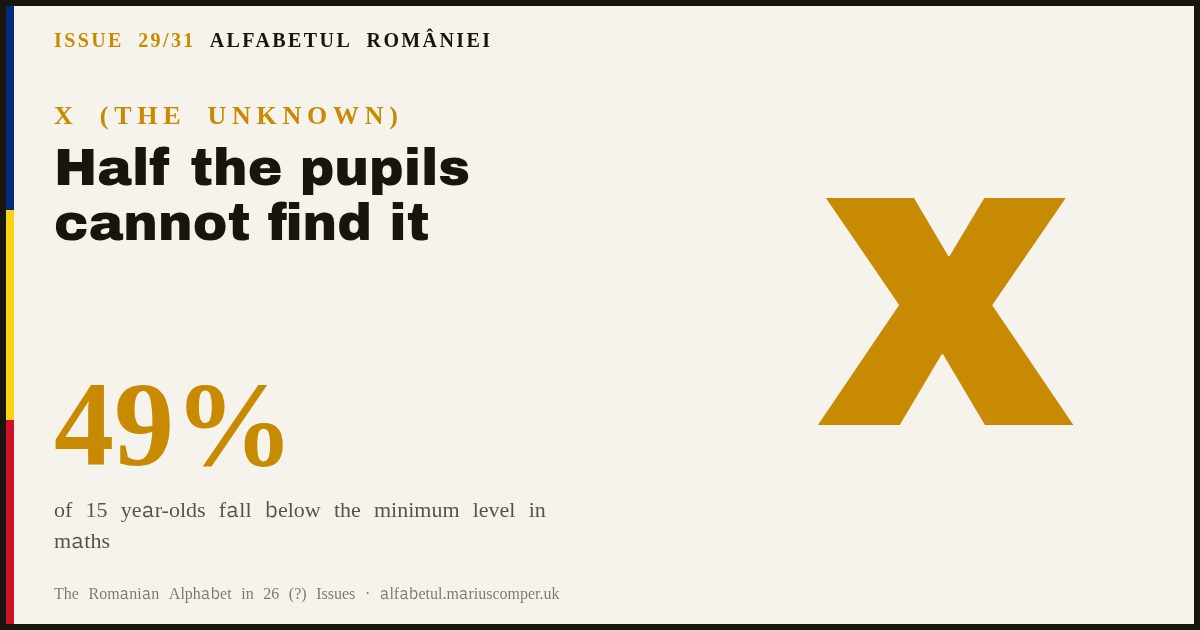
X (the unknown)

Half the pupils cannot find it

49%of 15 year-olds fall below the minimum level in maths

In PISA 2022, 49% of Romanian 15 year-olds failed to reach the minimum level in mathematics, about double the OECD average. Meaning one in two pupils cannot compare two routes on a map, convert a currency or check whether the change they got is right.

Why it is so

Maths is Romania's social exam: low marks concentrated in poor schools, tutoring for those who can pay and a curriculum that teaches formulas, not reasoning.

Sources: [30]

Special issue 30 / 31

Language filesborrowed letter

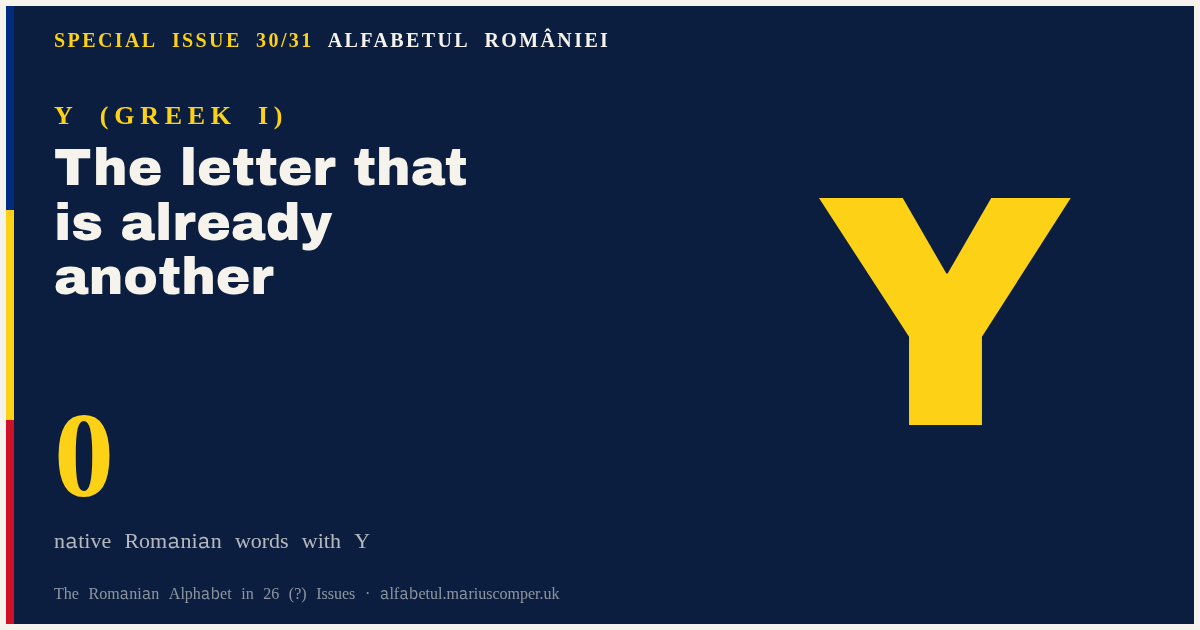
Y (Greek i)

The letter that is already another

0native Romanian words with Y

Y is an i that crossed the border without papers: it sounds exactly like our i, yet appears only in loanwords: yoga, yacht, nylon, hobby. Officially recognised in 1982 as well, it is the letter Romanian already had, under another name.

Why it is so

It stayed in the alphabet because the world's dictionary is full of it. Without y we could not even spell everyday English properly.

Sources: [33]

Issue 31 / 31

Money & institutions

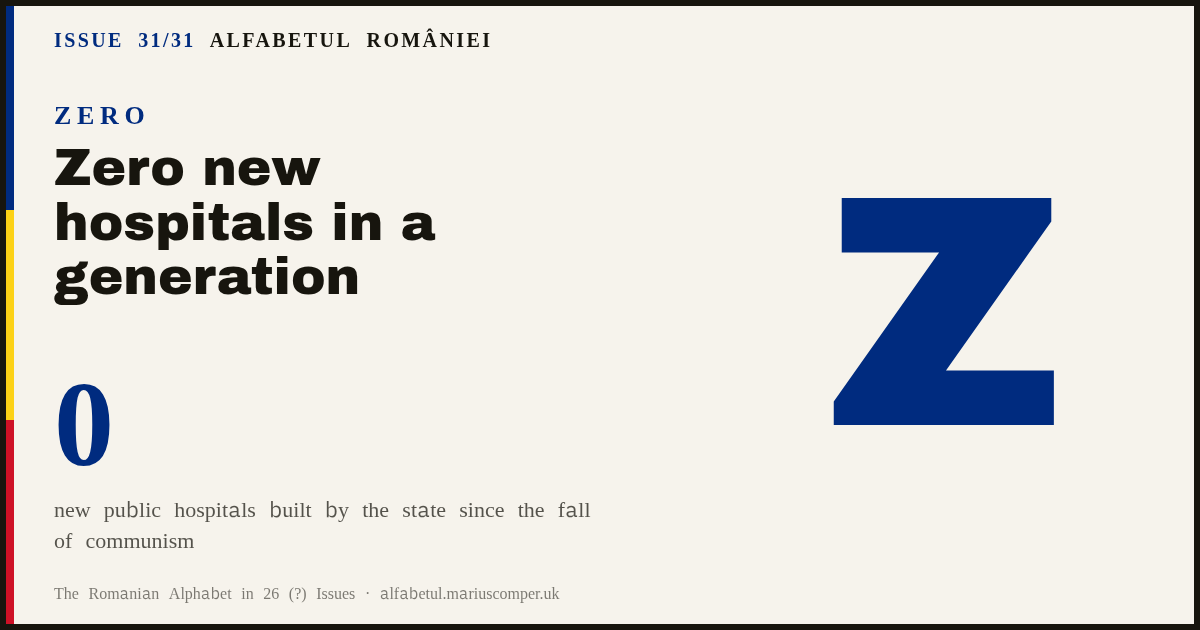
Zero

Zero new hospitals in a generation

0new public hospitals built by the state since the fall of communism

In over three decades of capitalism, the Romanian state has not built a single new public hospital from the ground up, Al Jazeera noted in a report on the system in crisis. Over the same period, public hospital beds fell by 40%: from 207,001 in 1990 to 125,034 in 2018.

Why it is so

Wings were modernised and wards repainted, but the ground-up project stayed in the drawer: too expensive for one term, too complex for a press conference. The regional hospitals promised a decade ago still await construction.

Sources: [31] [32]

Methodology

Every issue rests on a verifiable statistic, with the reference year next to the figure and the source at the end of the card. We used the most recent series published by July 2026: Eurostat, OECD, WHO, the National Institute of Statistics, the Court of Accounts, the European Commission, ILGA-Europe, ETSC, IRODaT. Where sources disagree, we chose the official or the most-cited variant. Comparisons with the European average use the same source and the same year. Nothing on this page is our own estimate.

Series sources

  1. OMS / Our World in Data, «In which countries do people drink the most alcohol», date 2019 · ourworldindata.org/data-insights/in-which-countries-do-people-dr…
  2. OCDE / Observatorul European al Sistemelor de Sănătate, «Romania: Country Health Profile 2023» · www.oecd.org/content/dam/oecd/en/publications/reports/2023/12/ro…
  3. Inventarul Forestier Național, ciclul 2012-2018; inventarul PIN/Merrill al pădurilor virgine (2005)
  4. INS, preluat de Libertatea (2019): 18.300 de biserici, 580 de spitale, 4.000 de școli, 1.500 de licee · www.libertatea.ro/stiri/avem-18-300-de-biserici-580-de-spitale-4…
  5. NPEU / Euro-Peristat, «Perinatal Health in Europe», indicatori 2015-2023 · www.npeu.ox.ac.uk/euro-peristat
  6. OMS, «Statement on Caesarean Section Rates» (2015): interval optim 10-15% · www.who.int/publications/i/item/WHO-RHR-15.02
  7. Eurostat (2024): 3,1 milioane de români în alte state UE, cel mai mare grup de emigranți din Uniune (22%) · www.zf.ro/zf-24/eurostat-romanii-reprezinta-cel-mai-mare-grup-de…
  8. Tudorel Andrei, președintele INS: estimări ONU ~4,5 milioane de români în străinătate, OCDE ~3,5 milioane (ianuarie 2026) · www.romania-actualitati.ro/stiri/romania/presedintele-ins-tendin…
  9. Comisia Europeană, «VAT Gap in the EU» (raportul 2025): România 30,0% în 2023, cel mai mare decalaj din UE · cursdeguvernare.ro
  10. Eurostat, cheltuieli curente cu sănătatea pe locuitor, 2022: România 858 €, media UE 3.685 €, Luxemburg 6.590 € · ec.europa.eu/eurostat/web/products-eurostat-news/w/ddn-20241115-…
  11. Agenția Europeană de Mediu, profil de țară România (2025): 12% reciclare municipală în 2022, 74% depozitare; media UE ~49% · www.eea.europa.eu/en/topics/in-depth/waste-and-recycling/municip…
  12. ILGA-Europe, Rainbow Map 2026: România 19%, locul 42 din 49, ultimul stat membru UE · rainbowmap.ilga-europe.org/
  13. Comisia Europeană, «Digital Decade Country Report 2024: Romania»: 27,7% competențe digitale de bază vs. media UE 55,6% · www.romania-insider.com/romanians-basic-digital-skills-2023-repo…
  14. Eurostat, cheltuieli publice cu educația, 2022: România 2,9% din PIB, ultimul loc UE; media UE 4,6% · ec.europa.eu/eurostat/web/products-eurostat-news/w/ddn-20250703-…
  15. Curtea de Conturi, audit ONJN (2023-2024): mize de peste 96 de miliarde de lei în 2024; risc fiscal de 3,1-3,6 miliarde de lei · www.mediafax.ro/economic/audit-onjn-romanii-au-mizat-peste-96-mi…
  16. Curs de Guvernare / ANAF (2024): 1,1 milioane de jucători, ~11 miliarde de lei cheltuite în 2023, 464 de firme acreditate · cursdeguvernare.ro/miliardele-de-euro-din-jocurile-de-noroc-cat-…
  17. CNAIR / 130km.ro: 1.416 km de autostradă în folosință la finalul lui 2025 · 130km.ro/autostrada.html
  18. ETSC, raportul PIN 2025: România 77 de morți la milion de locuitori în 2024, cea mai mare rată din UE; media UE 45 · etsc.eu/wp-content/uploads/ETSC-2025-Annual-PIN-Report-DIGITAL-V…
  19. Eurostat (2024): România 40,7% locuințe supraaglomerate, primul loc UE; media UE 16,9% · ec.europa.eu/eurostat/web/products-eurostat-news/w/ddn-20251222-…
  20. Eurostat, mortalitate infantilă 2022: România 5,5 la 1.000 de nașteri vii, cea mai mare rată din UE; media UE 3,3 · ec.europa.eu/eurostat/statistics-explained/index.php?title=Morta…
  21. INS, preluat de Edupedu.ro (martie 2026): 145.669 de nașteri în 2025, minim din 1930 încoace; 1990: 314.746; 1967: 527.764 · www.edupedu.ro/cel-mai-mic-numar-de-nasteri-din-ultimii-aproape-…
  22. IRODaT / Statista: România 3,44 donatori la milion de locuitori (2020), penultimul loc UE; Guvernul Spaniei: 47 la milion (2022) · www.lamoncloa.gob.es/lang/en/gobierno/news/paginas/2023/20230830…
  23. INS, Recensământul Populației și Locuințelor: 20.121.641 (2011) → 19.053.815 (2021) · www.recensamantromania.ro/
  24. Eurostat (2024): România 27,9% la risc de sărăcie sau excluziune socială, a doua cea mai mare rată din UE; media UE 21,0% · ec.europa.eu/eurostat/web/products-eurostat-news/w/ddn-20250430-…
  25. Eurostat, speranța de viață 2024: România 76,6 ani, printre cele mai mici din UE; media UE 81,7; Spania 84,0 · ec.europa.eu/eurostat/web/products-eurostat-news/w/ddn-20240503-…
  26. Eurostat (2025): România 19,2% tineri NEET (15-29 ani), cea mai mare rată din UE; media UE 11,0% · ec.europa.eu/eurostat/web/products-eurostat-news/w/ddn-20260528-…
  27. Eurostat, «Farms and farmland in the EU» (2023): 2,9 milioane de exploatații în România, 32,6% din totalul UE, cu 3,7% din producția standard · ec.europa.eu/eurostat/statistics-explained/index.php?title=Farms…
  28. F. Schneider / A. Asllani, «Taxation of the Informal Economy in the EU» (2022): economia subterană a României ~29% din PIB · www.icfm.ro/RePEc/vls/vls_pdf_jfme/vol11i1p81-91.pdf
  29. Eurostat (2024): doar 27,7% dintre români au participat la turism, ultimul loc UE; media UE 65,4% · ec.europa.eu/eurostat
  30. OCDE, «PISA 2022 Results, Country Note: Romania»: 51% dintre elevi ating nivelul 2 la matematică; 49% rămân sub prag · www.oecd.org/en/publications/pisa-2022-results-volume-i-and-ii-c…
  31. Al Jazeera English, «Romania's health system in crisis»: niciun spital public nou construit de stat de la căderea comunismului · www.youtube.com/watch?v=HEm0zTNqBUo
  32. G. Guțoiu, «Development inequalities of Romanian physical public healthcare infrastructure» (2021): paturi publice 207.001 (1990) → 125.034 (2018) · humangeographies.org.ro/articles/1511/a1513.pdf
  33. Wikipedia, «Romanian alphabet»: 31 de litere; Q, W, Y recunoscute oficial în 1982, doar în cuvinte străine · en.wikipedia.org/wiki/Romanian_alphabet

The alphabet ends at Z. The series does not.

The country is rewritten every year, one new figure next to each letter. This edition photographs Romania in July 2026.

Why 26 (?) and not 31

The Latin alphabet has 26 letters. The Romanian one has 31: the same 26, plus ă, â, î, ș and ț, five fully-fledged letters with their own sounds and their own slots in the dictionary. The question mark stays in the title because the right count depends on how Romanian you want your counting to be. We chose 31: a series about Romania cannot skip the letters that make Romanian Romanian.